There’s a version of this conversation that has been happening in teacher lounges and staff meetings across the country for the past two years: AI is going to make our jobs harder. Students will use it to cheat. It’s going to eliminate the careers we’re supposed to be preparing kids for. We don’t even know how to use it ourselves.
All of that anxiety is understandable. Some of it is even legitimate. But there’s another version of this conversation, the one worth having, that starts from a different premise:
What if AI is the most powerful tool school counselors and teachers have ever had access to? What if, used well, it solves some of the most stubborn problems in career readiness education?
Here’s something almost nobody says out loud: teachers don’t know what careers connect to what they teach. Not because they’re bad teachers. Because nobody taught them that, and the landscape of careers is enormous, constantly changing, and impossible to keep up with.
“Every teacher is a career educator, nobody taught them that. They don’t have the content knowledge, so we have to help them.”
Think about what we’re actually asking a high school math teacher to do in a future-focused school. We want them to teach quadratic equations and also connect that content to real careers in a way that feels authentic and meaningful to their students — including students interested in fashion marketing, environmental science, sports analytics, game design, and twenty other fields the teacher may know very little about.
That’s not a reasonable ask without support. And historically, the support hasn’t existed.
AI changes that.
What AI-powered career exploration actually looks like in the classroom
Shira describes a scenario that Orchard is built around: a student who is learning quadratic equations but is passionate about fashion marketing. Instead of those two things existing in separate mental compartments, “school” and “what I actually care about”, the student can ask:
“I’m not interested in quadratic equations. I’m interested in fashion marketing. What careers in fashion marketing actually use math like this? What would I need to study to get there?”
A good AI tool answers that question specifically, honestly, and in a way that opens doors instead of closing them. It turns an abstract academic skill into a concrete bridge to a real future.
For the teacher, it means they don’t have to be the expert on every career path. They just need to know how to use the tool and how to get their students using it to go deeper.
The comparison to past technology is instructive
We’ve been here before. When Google arrived, teachers worried students would use it to cheat. When Wikipedia became a student’s first stop for research, educators scrambled. When Siri showed up on every iPhone, there were breathless op-eds about what it meant for critical thinking.
Looking back, the schools that thrived were the ones that taught students how to use these tools well — how to evaluate sources, how to ask better questions, how to use the answer as a starting point rather than an ending point.
“We can’t be afraid that AI helps students cheat, Google could have helped them cheat 25 years ago. Instead, we need to teach them how to use it the right way.”
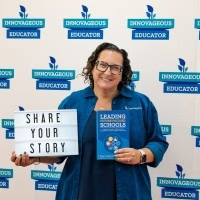
— Shira Woolf Cohen
AI is the same. The question isn’t whether students will use it. They already are. The question is whether they’re using it with any guidance or on their own, however they figure it out.
AI prepares students for a workforce that runs on AI
Here’s the other half of the argument, and it’s just as important: the students sitting in classrooms right now are going to spend their careers working with AI tools that don’t exist yet. The specific tools will be unrecognizable. The underlying skill, knowing how to prompt, evaluate, and build on AI-generated output, is already essential.
Students who learn to use AI purposefully in high school arrive at the workforce (or at college) with a genuine advantage. Students who were shielded from it, or only ever saw it through the lens of cheating scandals, arrive unprepared.
Teaching students to be adaptable, creative, and effective with the tools in front of them isn’t a distraction from career readiness. It is career readiness.
What this means for counselors specifically
School counselors are already stretched impossibly thin. The national average is one counselor for every 408 students. Comprehensive, individualized career guidance, the kind that actually moves students toward a real plan, is something most counselors simply don’t have the bandwidth to provide at scale.
This is exactly where AI earns its place. Not by replacing counselor relationships, which are irreplaceable. But by handling the parts of the work that are time-consuming and scalable: career exploration, pathway mapping, skills and interests discovery, initial research on education requirements.
When students arrive at a counseling session having already explored careers that genuinely interest them, having already mapped out education paths and identified skills gaps, that session becomes radically more productive. The counselor can do the work only a counselor can do: ask the deeper questions, challenge assumptions, build the relationship.
85% of students prefer using AI tools when paired with the emotional intelligence of school counselors.
2024 Annual Student Quest Survey conducted by IC3 Institute
The practical answer to the AI question in K–12
Don’t ban it. Don’t ignore it. Don’t wait for a district policy to tell you what to do.
Start by finding tools that are actually built for students (like Orchard), that are age-appropriate, educationally grounded, and designed to surface possibility rather than just produce output. Use them with intention. Teach students to interrogate the results, ask follow-up questions, and connect what they find to their own goals and values.
That’s the future-focused approach to AI. And it’s not complicated. It just requires the willingness to stop treating technology as the enemy and start treating it as the most powerful career counselor your school has ever had access to.
Meet Orchie. AI career guidance built for students and counselors.
Orchard’s AI career readiness platform helps students explore careers, discover their strengths, and build a real action plan — while giving counselors the data and time they need to have better conversations.
No, AI cannot replace school counselors, and the best AI tools for education aren’t designed to. What AI can do is handle the parts of career guidance that are time-consuming and scalable: helping students explore career options, identify strengths, map out education pathways, and build initial action plans. What it cannot do is form a trusting relationship with a student, recognize when someone is struggling beneath the surface, or provide the kind of human judgment that makes a counseling conversation transformative.
The most effective model pairs AI-powered exploration with counselor-led advising. Students arrive at counseling sessions having already done meaningful self-reflection and career research, which means the counselor can spend their limited time on the conversations that only a human can have. Research consistently shows students are more receptive to career guidance when they’ve already engaged with the topic on their own terms first.
The question isn’t AI or counselors. It’s how to use AI to make counselors more effective at the work that actually matters.
What AI tools do school counselors use?
AI tools for school counselors fall into a few categories:
Career exploration platforms help students discover careers that match their interests, strengths, and learning styles. These tools typically include skills and personality assessments, career spotlight videos, and pathway comparisons across college, trade, apprenticeship, and workforce routes. Orchard’s AI career counselor, Orchie, is built specifically for this use case in K-12 schools.
Scheduling and caseload management tools use AI to help counselors prioritize their time, flag students who may need outreach, and automate administrative tasks like appointment reminders and progress tracking.
Curriculum and lesson planning tools help counselors and teachers build career-connected content without having to research every industry from scratch — a significant time saver given that most educators weren’t trained in career development.
Analytics and reporting dashboards surface patterns across a counselor’s entire caseload — which students have engaged with career planning, which are behind on key benchmarks, and where intervention is most needed.
For schools focused specifically on college and career readiness at scale, platforms like Orchard combine several of these capabilities in one place, integrating with existing school systems so counselors don’t have to manage another disconnected tool.
How is AI being used in career readiness education?
AI is being used in K-12 career readiness education in three primary ways:
Personalized career exploration. Traditional career assessments give every student the same questions and a list of job titles at the end. AI-powered tools can have dynamic, conversational interactions with students — adapting based on their responses, connecting their stated interests to real career pathways, and surfacing options they wouldn’t have thought to search for themselves. This is especially valuable for students who don’t have professional networks at home to draw on.
Connecting classroom content to careers. One of the biggest gaps in career readiness is that most teachers don’t have the knowledge to explain how their subject connects to specific careers. AI tools can give teachers instant, specific answers — so a math teacher can tell a student interested in fashion marketing exactly how data analysis, pricing models, and trend forecasting rely on the skills they’re learning in class. This is what makes the “future-focused mindset” Shira Woolf Cohen describes actually scalable across an entire school.
Action planning and goal tracking. Rather than a one-time career interest survey, AI can help students build personalized, step-by-step action plans tied to their specific career interests, grade level, and local opportunities — and update those plans as students’ interests evolve. Counselors get a real-time view of where each student stands, making it easier to identify who needs support before they fall through the cracks.
The common thread across all three is that AI handles what can be automated — research, personalization, tracking — so that human educators can focus on what can’t: relationship, judgment, and the kind of guidance that changes a student’s trajectory.